Frozen Gestures
November 15, 2026 – April 11, 2027
Frozen Gestures traces the exploration of expressive movement in sculpture from Abstract Expressionism to the present. The exhibition takes its title from a term used to describe the moment when Lynda Benglis’ pours of pigmented latex, spilled directly onto the floor, solidified into their final form. Created in the late 1960s, these works marked a pivotal shift in contemporary art by blurring the boundaries between painting and sculpture. For Benglis, the phrase “frozen gesture” refers not only to a physical process but also to a psychological or emotional act, as in the expression “it was a lovely gesture.”
By the early 1990s, Frank Stella similarly sought to create a painterly “frozen gesture” that could be formed instantaneously without evidence of the artist’s hand. He achieved this through processes such as pouring molten metal into sand molds and employing emerging digital technologies, including 3D printing to generate fluid forms that evoke the sweeping brushstrokes of the Abstract Expressionists.
This exhibition is as much about painting as it is about sculpture. Approaching sculpture from the perspective of painting liberated these artists from many of the traditional concerns of sculpture, including weight, mass, and support, that preoccupied Minimalists such as Robert Morris and Donald Judd during the 1960s. Working with literal, three-dimensional space also offered a solution to one of modernist painting’s primary dilemmas: how to eliminate illusionistic pictorial space without sacrificing the optical marvels that make painting so compelling. Painting had another limitation as well: it is physically static.While painting can suggest movement and gesture, sculpture has the capacity to activate space through its physical presence.
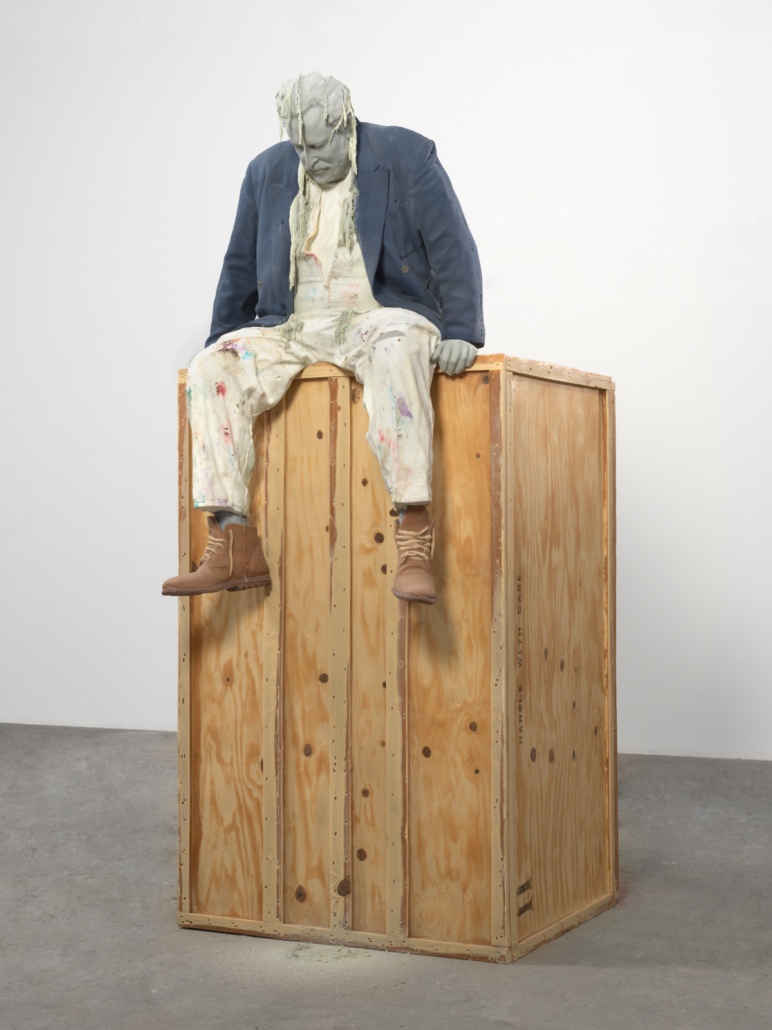
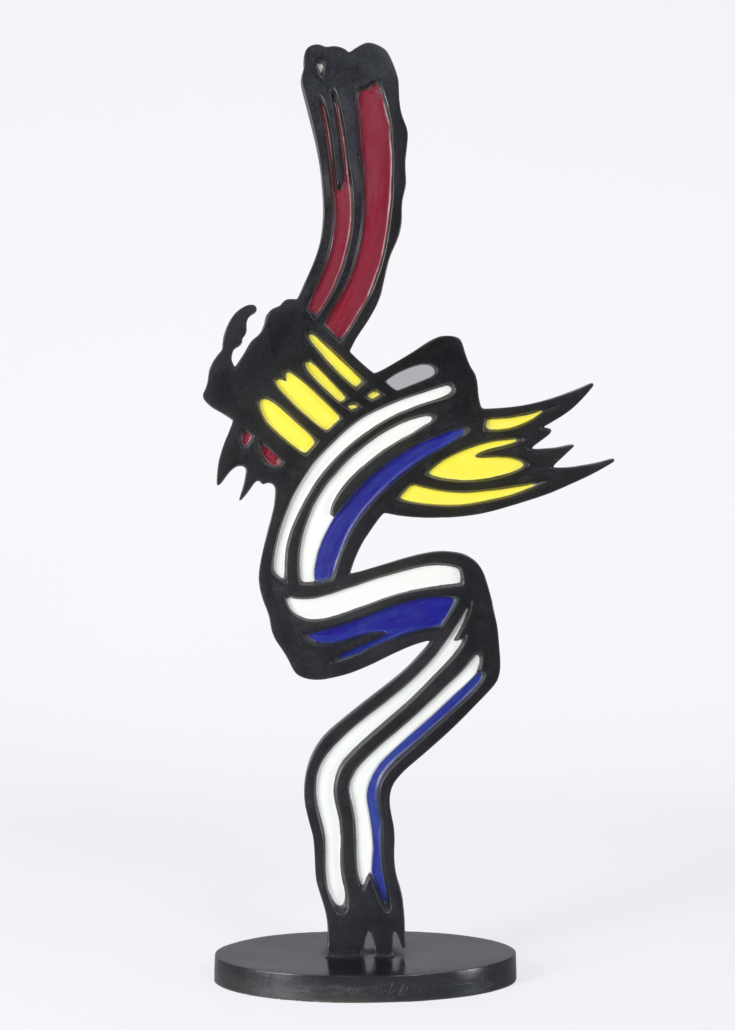
Movement appears in myriad ways in the exhibition. David Smith’s Black Flock (Raven) (1960), is comprised of abstract, black steel forms that resemble ominous birds perched restlessly on branches. Other artists sought to capture ephemeral phenomena, such as steam rising from a coffee cup in Roy Lichtenstein’s sculpture or moisture gathering at dawn in Teresita Fernández’s Dew (2003). The use of malleable materials offers another means of introducing movement, as seen in Benglis’ paint pours and the pliant paint skins Kennedy Yanko drapes across her sculptures. Urs Fischer’s monumental sculpture Julian (2014) is cast in wax and designed to be burned like a candle, gradually melting over the course of the exhibition.
The frozen gesture as a metaphor for life, death, endurance, and erasure is suggested in Francis Alÿs’ video Paradox of Praxis 1 (Sometimes Making Something Leads to Nothing) (1997), which documents the artist pushing a large block of ice through the streets of Mexico City until it melts after nine hours. In contrast, Lorna Simpson’s Haze (2018),
presents glass icebergs thar remain perpetually frozen in time. Ideas of generational succession emerge in the work of Julian Schnabel. His first fully three-dimensional sculpture, Balzac (1982), ultimately gave rise to a family of subsequent sculptures derived from molds originally used to cast it in bronze.
The viewer’s participation is implicit in the experience of all sculpture in the round, as the work must be circumnavigated in order to fully experience it. The inherent theatricality of sculpture was amplified by a generation of Actionist and performance artists during the 1960s and early 1970s, influencing the next generation of artists such as Franz West, who challenged traditional boundaries between the sculpture and viewer through interactive forms. West considered even his ‘Legitimate Sculptures,’ which are not meant to be handled, interactive as their forms provoke imaginative engagement.
The sculptures of Pol Bury, Robert Chambers, and Jean Tinguely escape their frozen state through mechanical means. These kinetic works dynamically extend into the viewer’s space, through continuous action.
Frozen Gestures presents works by Francis Alÿs, Lynda Benglis, Pol Bury, Robert Chambers, John Chamberlain, Teresita Fernández, Urs Fischer, Lonnie Holley, Karen Kilimnik, Willem de Kooning, Jeff Koons, Morgan Leigh, Roy Lichtenstein, Robert Morris, Elizabeth Murray, Will Ryman, Julian Schnabel, Lorna Simpson, David Smith, Josh Smith, Frank Stella, Jessica Stockholder, Jean Tinguely, Franz West, Rachel Whiteread, and Kennedy Yanko.
Curated by Bonnie Clearwater, Director and Chief Curator
Generously Supported by:
Jerry Taylor and Nancy Bryant Exhibition Fund
The Jacarlene Foundation